February 27, 2009
UNHCR Forum, Cape Town
10.02.09 and 24.02.09The UNHCR hosts regular meetings between different sets of NGO’s all devoted to the cause of aiding and assisting the refugees in South Africa. These meeting also featured discussions on the activities and challenges faced by the various task groups: Food Task Group, Income Generation Task Group and the Participatory Assessment Task Group. ADRO made a point during the discussions on the Food Task Group that there is still a great need of food in the Refugee camps in the Cape Town area. Even though the camps are officially closed, as many as 300 to 500 refugees remain in the camps. There was a profound debate about what needs more attention, the short term needs of the refugees or the long term needs. Food being a short term need. There was a general agreement that in the end it is more important to teach the refugees skills so that they will have the capacity to take care of themselves. Yet it would be hard for anyone to learn new skills on an empty stomach. It is important to concentrate on the long term needs of the refugees by concentrating on the tasks of the Income Generation Task Group, but the short term need of food is just as important, and is a fundamental human right. It’s important for all the NGO’s focusing on this area to work together to make the distribution of food as efficiently and effectively as possible.
A big part of this meeting focused on another task group focusing on creating a referral network. The referral network is organized by PAX, and they are in the process of organizing a database which will be comprised of all the relevant and up to date information from the various organizations involved in the forum, but will eventually spread out into other areas as well. If violence were to break out again, having a database consisting of all the interested parties, their contact details and their area of focus, will be a great benefit. The website would be made up of different section. The sections that are categorized are: Refugee rights, Health, Education, Skill's Training, Accommodation/Shelter, Social Welfare, Employment, Advocacy, Research, Legal, Protection, Conflict Resolution, Children, Women, and disabled.
The Department of Home Affairs was discussed as well. This department is creating a lot of problems for many refugees as they are taking their time processing the relevant documents. Many of the NGO’s have bad experiences concerning this department, so it was discussed in the meeting on the 10th of February that this forum invite the Department of Home Affairs to a special meeting where they can discuss the challenges the DHO is facing and figure out ways that the various NGO’s can assist the DHO in solving their challenges. This meeting could be a first step to creating a better relationship between the DHO and the various NGO’s. On the 24th of February it was announced that the meeting with the DHO would take place on the 3rd of March. ADRO will be attending that meeting.

February 26, 2009
Parliamentary Monitoring: SASSA
28.01.09Portfolio Committee Meeting- Annual Report 2007/2008
ADRO attended the SASSA portfolio meeting in order to lobby the department and acquire further information regarding the Social Relief of Distress grant in relation to refugees.
The Social Relief of Distress (SRD) grant was an area of particular focus, since more people require social assistance in the global economic crisis. The department received a large amount of cash in December and therefore appeared to pay out to more people. With this cash running out, SASSA must again limit the amount of people who are eligible for the grant. The SRD is designed to support families outside of the assistance framework, but only for a short period (3 months, 6 months in exceptional circumstances). Beneficiaries might receive cash or a food voucher. Currently, only cash is offered to those living in the Western Cape. SASSA may also assist with the purchasing of school uniforms for those claiming SRD. It was emphasized that the SRD is not intended to support those undertaking higher education, to the disgruntlement of some parliamentarians. Because SASSA have a fixed amount to spend on social grants, restrictions on who qualifies must remain tight.
The question of whether refugees are eligible for this grant was posed on behalf of ADRO, by the chairperson. SASSA confirmed that only adult disabled refugees, and those who are fostering a child are able to receive this benefit. SASSA’s spokesperson on this matter implied that the department was reviewing the current legislation with the possibility of expanding their definition of a refugee, but did not comment further on the immediate impact this had on the refugees displaced last year due to xenophobic attacks. Such limited criteria means that relatively few refugees can benefit from this grant, and many will remain without government assistance of any kind. The answers provided by the committee confirm the requirements, responsibilities and expectations of local NGOs, such as ADRO, in providing continuous support for these communities.
UNHCR Forum on the Reintegration and Protection of Refugees
27.01.09
Food Task Group: As many of the refugees are still in the camps, too afraid to reintegrate into mainstream society, the need to distribute food is still great. While the main aim is to try and reintegrate the refugees back into the communities, many of them have yet to leave. The government has decided to stop its shipments of food into the camps in way to force the refugees back into the communities. But whether this is the right way to go is not know. There are still some organizations that distribute food to the refugee camps, ADRO being one of them. In the last 2 months ADRO has made regular visits to the Bluewaters refugee camp, providing them food and other necessities. But ADRO’s funding is slowly running out and thus needs to find ways to continue its support for the refugees. The point was made by the UNHCR whether the distribution of food is the reason the refugees stay in the camps. There was also further discussion about the main duty of the Food Task Group. Its duty is not actually to deliver food to the camps, but to coordinate the issue with the other refugee organizations. ADRO and Scalabrini were to be the contacts for the other organizations if they were looking to distribute food. No matter what ones views on the subject, as long as the refugees stay in the camps, they will need to supplied with food. The Food Task Group should coordinate and discuss with the other groups in order to find ways to get some funding or assistance in providing the refugees with food.
Income Generation Task Group: The point of the matter is that the refugees cannot stay in the camps indefinitely. They have to return to the communities, but it is important that they learn to sustain themselves by assisting them in finding a job or training opportunities. Yet there are a lot of challenges facing this task group. They have been going to a number of refugee camps picking up CV’s, but many refuges either lack a CV all together, or they will be unable to get contacted, as they aren’t in possession of a phone. These task groups also have problems finding people who will support the refugees in providing them with training opportunities. Scalabrini has announced that it has approached the University of New York to see if they can create a program that would assist the refugees in creating small businesses and provide training for such purposes. Many refugees believe, especially the ones from Somalia, that the only skills they have is to run a business. A major problem, which needs to be addressed, is that refugee businesses could have the affect of undercutting South African owned businesses, which would lead to increasing resentment among native South Africans and cold thus lead to more xenophobic attacks.
Participatory Assessment Task Group: An important aspect of all the previously mentioned issues is to have a comprehensive framework in place to assess the performance of all the programs aimed at refugees. This task group finished Part A of the Assessment form, which is just a quick scan of the work being done, and it’s in the process of creating Part B of the assessment, which will involve comprehensive interviews with refugees. It’s very important to take the points of view from all the affected parties. One cannot create programs designed to aid the refugees, without taking their views into account. Refugees might have different priorities than those running the organizations and thus these two groups need to get together and discuss the issues in order to provide the best possible services. A comprehensive participatory assessment will greatly aid these organizations in preparing measures in case anything in the scale of the xenophobic attacks happened again. If it were to reoccur, then the organizations would be better prepared to handle the situation. It’s very important to have a system in place that enables us to look at the impact of everything we do.
Some thoughts
ADRO will continue to take part in this forum as it is an important way to create networks with the other organizations devoted to the lives of the refugees. By working together with these other groups we can continue to learn more on the issues affecting the refugees, which will aid us when we advocate on behalf of the refugees in our many discussions with parliamentary ministers, officers or other groups designed in some way to assist refugees and other vulnerable people. The main aim of anything that ADRO does is to help the refugees live a life of dignity as promised to them in the South African constitution and the Refugee Act of 1993.
Parliamentary Monitoring Report
20.01.09
Annual Report of the Unemployment Insurance Fund (UIF)
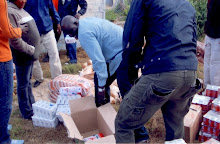
Food drive to the Bluewaters Refugee Camp
20.01.09
· 600 kg of Maize flour
· 600 kg of Red sugar Beans
· 240 liters of Milk
· 100 packs of porridge
Due to the fact that we did not have an up to date list of the current numbers, we could only make guesses and distribute the food as fair as possible. We also received several requests for school uniforms, books, sugar and, most urgently, clothes and clean towels for newborn babies, since there are at least four women in the camp that are due to give birth before the end of the month. ADRO has received clothes donations from Catholic Welfare Development (CWD), and hopes to sort and distribute these sometime next week.
Reflections
ADRO’s funding will run out at the end of January 2009, so ADRO will have to make it known to the refugees how they can obtain funds in order to provide for themselves. As it stands, refugees are currently entitled to apply for 3 types of social grants: Foster Child Grant, Disability Grant and Social Relief of Distress. They need to be educated in the ways to obtain these grants. As many of the refugees have experienced a disaster in the previous year in the form of the xenophobic attacks, many of them will be eligible for the Social Relief of Distress. As the Department of Home Affairs is making it hard for many of the refugees to renew their refugee status, many of them believe that they might not be able to apply for the social grants. But as it stands at the moment, you can receive a social grant with alternative documentation such as a baptismal certificate, road to health care clinic card, latest school term results, or a sworn statement from one of the following persons of repute: social worker, preacher or a councilor. At the moment ADRO is working to clarify with the Department of Social Development whether a refugee can claim Social Relief of Distress if he is only in possession of an expired refugee permit and is currently waiting for the Department of Home Affairs to issue a new one. Once we have more concrete information regarding this issue we will forward the information to the refugees and other vulnerable people.
Dental Care visit to Bluewaters Refugee Camp
12.01.09